
We have a greyhound named Bardot. A popular myth about greyhounds is that they are high-energy dogs that need tons of exercise. That is false. While they are super fast, they are also incredibly lazy. They are the world’s fastest couch potatoes. They are basically just giant cats. Whenever I take Bardot for a walk, there is usually an initial burst of enthusiasm, but it quickly degrades into an annoyingly slow pace with frequent stops to sniff anything and everything of interest. Needless to say, this gives me plenty of time to listen to podcasts.
Over the weekend, I was listening to a podcast while walking Bardot that included a Gen-X host and a Millennial interviewee. The Gen-Xer made a joke about Millennials, to which the Millennial responded, “You guys used to put tinfoil on your rabbit ear antennas because you thought it improved the reception.”
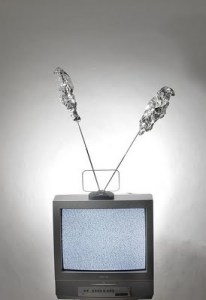
“Hey!” I thought to myself, “We used to put tinfoil on our rabbit ears. What does he mean by ‘thought it improved the reception?’”
When I returned home, I did a quick google search for “does tinfoil on rabbit ears help” and…it does not. This is embarrassing.
Until the age of 12, I lived in the southern part of Delaware, affectionately referred to as “slower lower.” My Grandpa Warnick and Aunt Mary Kathryn still lived on the farm where my dad grew up, and we would frequently spend our Saturdays there helping out with various chores (picking lima beans, baling hay, tending animals, etc.) Once the work was done, we would all gather in the family room of the farmhouse for dinner. Since there wasn’t a table big enough for everyone to sit at, we usually would just spread throughout the room and eat off of TV trays. (note from Scott: Derek should explain here what a “TV tray” is since it is another Gen-X relic. It’s basically a standup version of an airplane tray table. It’s only slightly better than eating off your lap)
On the TV, we would watch NASCAR (We rooted for Bobby Allison [he was a Christian man] and frowned at Richard Petty [he cussed and smoked cigars]. I am not making any of this up.), The Lawrence Welk Show, and Hee Haw, often in that order. To this day, I was certain the only reason we got any kind of TV reception in that part of the country was because Grandpa Warnick had the foresight to cover the tips of the TV antenna with tin foil. I have been living a lie for 40 years.
My very first job in CME was at Thomas Jefferson University in Philadelphia in the early 2000s. The Internet was advancing beyond its toddler phase, and more and more organizations–TJU included–were adapting on the fly to utilize this untapped resource. One of my first big projects at TJU was to turn our CME webpage from nonexistent to useful for our learners. Overall, I think I did a pretty good job with it, but I definitely had a couple tinfoil-on-the-antenna ideas that, in hindsight, were not nearly as helpful as I thought they would be at the time.
For instance, I thought it would be an amazing idea if we recorded all of our grand rounds sessions and posted the raw video on our website for people to watch. It was not. I also thought that people would love sitting in front of their desktop computers reading 15-20 page journal articles in PDF format instead of settling into a comfy chair with a hardcopy journal in hand. They did not.
The funny thing is, it’s 20 years later and I am still seeing these types of antiquated CME programs. Live symposia that are recorded and converted into online programs with little additional formatting. Journal articles or monographs that are posted online in big blocks of text or not optimized for mobile devices. While the intent is valid, there is little actual value added.
If you ever find yourself stuck in a rut with CME program design and needing a spark to modernize, may I humbly suggest that you head on over to the CMEpalooza Archive? (note from Scott: Did anyone else read on and on and on wondering what the heck this all has to do with CMEpalooza? I’m glad Derek finally got here — well, sort of glad). We have an entire section of the archive that focuses specifically on educational design, with more than 40 different sessions to choose from, all free. Hopefully you can find something there that will help you get rid of the tinfoil and throw away the rabbit ears for good.

 CMEPALOOZA
Thank you! So true and also difficult to get out of the rut. During the CACME meeting on Friday, Scott and Audrie shared the escape room concept for CME – amazing! Allison Kickel walked us through how to use “SoMe” (social media) for CME – it changed my mind. It is worth learning more from them about these innovative ways to deliver education.