Archive Updates

Every once in a while I do a little tinkering in the Archive section of the CMEpalooza website to try to make it a bit more user-friendly. I’ve talked with a couple people recently who are new to the CME world, and both mentioned how helpful the archive has been for them in training for their roles. Similar to the motivation one gets to clean up the house when you learn that visitors are coming (or as my Lancaster County relatives would say, “read up the house”), realizing that people were visiting the archive was a good nudge to spruce the place up a little.

There are two updates to the CMEpalooza archive that I wanted to highlight. The first is that I updated our previously labeled DEI section to now be Diversity, Equity, and Inclusion. A small change, yes, but not a minor one. The term “DEI” has unfortunately been co-opted from its original meaning of fair treatment and opportunity, and it’s important for us to emphasize the accurate meaning of those three letters. I understand it’s not something that is going to change the world, but we can still do our small part to make it a better place.

The other update is that I pulled out all of the pre-2015 sessions from the individual topics and stuck them in one big list at the bottom of the archive. It was time. It reminded me of when I went through all my old baseball cards last year, and instead of getting rid of them, I dumped them in a huge plastic storage container in the basement. Is there anything of value in there? Probably not…but maybe!

After 10+ years, the lists of sessions under the individual topics were getting too unwieldy to be useful. I should probably pull out even more, but for now we’ll stick with 10 years worth of sessions and see how that goes. If you have any other suggestions for making the archive more useful, let me know!

The Nooks and Crannies of CME: Who Makes the Final Call on Content?

The Umpire Calls That Replay Won't Fix - WSJ

As the agenda for CMEpalooza Spring continues to take shape (we’ve made some recent additions you can check out if you feel the urge), you’ll notice that the big picture concepts of CME are fairly well covered by our panels. These are some of the broader debates we all have when we are developing education: our educational design, our technology platforms, our outcomes plan…things like that. And don’t get me wrong — these are all critical to discuss and debate at length, which we’ll absolutely do on Wednesday, April 16.

But in this periodic feature that I rolled out earlier this year, we’ll look at some of the nooks and crannies of CME that don’t get discussed often enough but are nonetheless critical for the community to pick over and understand.

Today’s Topic: Who Makes the Final Call on Content?

One of the basic principles of CME activities is that there is going to be a clinician (or group of clinicians) who will be the “face” of our education. The level of their involvement in the content development process will, of course, vary depending upon the educational design. In some cases, they’ll serve more as planners and reviewers while our content team (typically, full-time or freelancer medical writers) takes on the brunt of the work; in other instances, the faculty will take a more hands on role (for instance, when creating a slide deck for a live presentation). In either scenario, things can get tricky when we disagree with the advice of our faculty experts either on a clinical matter in which they undoubtedly have more overall knowledge than we do or are something more nuanced like wording or slide design.

Let’s look at a couple of real-world scenarios with some Monday morning quarterbacking from me to give you an idea of what I’m talking about. And yes, these all really happened.

SCENARIO #1: This one happened about 18 years ago, when I was notably younger, had considerably more hair, and felt the need to assert myself a little more to carve out my space within my employer. We were in the slide review room prior to a satellite symposium (do people still do formal slide reviews onsite? I haven’t been part of one for many years) and going through the content of one faculty member in particular who had sent us his deck 2 days prior. I had been the one doing the content validation (ie, fact checking) for this specific activity, and I noted that he had made an error in his analysis of the trial data on one of his slides.

Since we were so close to the day of the symposium (and slide review), I didn’t mention anything until we were onsite and I had a chance to discuss things with this faculty member face to face. Perhaps not appreciating being told, “You are wrong,” by a relative newbie to the CME space, this faculty member pushed back and refused to change the wording on his slide. Eventually, we got the faculty chair to weigh in, and he agreed with my perspective. However, he was a bit more diplomatic than I was, and helped to broker a compromise solution.

MONDAY MORNING QUARTERBACK: While I was in the right from a factual perspective, I probably should have let this go once the presenting faculty member disagreed with my assessment. I don’t remember the precise substance of the issue, but I am fairly sure it was relative minor and not essential to the educational messages of his presentation. Now, if it was more substantive, I have no problem with someone on our end holding their ground and fighting hard for their position. Of course, it helps to have someone (ie, medical director, faculty chair) backing you up.

SCENARIO #2: I was working more recently on a case-based online activity where we had held an initial planning call with our two faculty members to hammer out the general direction of two patient scenarios. Our medical writer on the project took this direction, and I worked with her to craft sensible details for each case. During the initial review of the complete content, one of our faculty members inserted a comment that read as follows: “Why don’t we change this from an IgG case to an IgM case? It might be less common, but could be a more interesting case.”

A few important things to note here:

  1. She had agreed on the planning call (or at least had not audibly disagreed) that we’d create an IgG case. It doesn’t matter if you know what IgG is by the way, just know that it’s a different subtype of one disease state.
  2. She wasn’t saying that anything was factually incorrect in the case that had been created, just that we could have gone in a different direction
  3. Making her suggested change would have had a lot of downstream effects on the details and progression of the case
  4. We were already several weeks behind in our launch timeline and this would have pushed us back even further

So in my response to her, while we accepted the majority of her suggested edits, I politely explained that, while her suggestion was certainly valid, we did not have the time to make all of the changes that would have been necessary if we followed down this new path. I encouraged her to let us know if there was anything factually incorrect with the case we had created. Fortunately, our faculty member was fine with this explanation and agreed to leave the case’s direction alone.

MONDAY MORNING QUARTERBACK: One of the points I did not mention was that I initially approached our freelance writer to find out, “How much of a pain would it be to make this change?”

Her response, in a nutshell? “A big, big pain. I’ll do it if I have to, but this really would take a lot of time.”

That gave me all the information I needed. Faculty certainly may change their mind on specific items from time to time, and we often need to just “go with the flow.” But when they make a suggestion that significantly alters a decision they had already previously make on what seems like a whim, we can be confident in steering them gently back in the original direction.

SCENARIO #3: A few weeks ago, I got a slide deck from a faculty member that would be part of a live symposium happening later this year. It was generally well done — sensibly organized and thorough. But, as happens quite often, there was far too much information packed on some of the slides. The font size for some of the text was 18 pts. or less, which may be readable on the computer screen when you are sitting 5 feet away from the monitor, but is impossible for someone sitting in the back of the conference room to see on the monitors at the front of the room (the dreaded, “I know you probably can’t read this, but let me tell you what it says” moment from the podium that we’ve heard over and over).

When I went through the deck our faculty member submitted, I did the best I could to simplify some of the information on the busier slides so that they would be more likely to be viewable onsite.

My efforts were not well received.

“Can you put slides 6, 8, and 13 back the way they were?” our faculty member wrote. “I’m afraid they’ve lost the message I am trying to tell with your edits.”

Again, there was nothing factually wrong with the information on the initial (or revised) slides. Our faculty member simply wanting things the way she wanted them. Could I have pushed back again and said, “These are not going to be readable onsite”? I suppose so. But this was one of those situations where it doesn’t always help to unnecessarily cause friction. Yes, I’ll be cringing onsite when these “original” slides come up and everyone in the back of the room has to squint to read the small text, but I’ll trust our faculty to “tell her story” the way she wants.

MONDAY MORNING QUARTERBACK: This one is pretty fresh in my mind, so I don’t know if I would have done anything differently. We’ll see how things go onsite and if this comes up in our faculty postmortem.

But the takeaway for this one is to choose your battles. It’s always OK to make your best recommendation, but if you find points of disagreement, it’s also OK to give a little to avoid unnecessary confrontation.

Agree or disagree with anything/everything I’ve said here? I sure hope so. Feel free to share your thoughts in our comments here or through our LinkedIn posts.


Let’s Talk About Stress 2.0

(Embarrassing note: yes, this might be the second time you are seeing this post. I accidentally hit the “publish” button yesterday while I was in the middle of updating it and it sent out the auto-generated email before I could fix it. This version is much better, with tips from more people and better formatting. The irony of stressing out about a blog post about stress has not been lost on me,)

Let’s talk about stress, baby
Let’s talk about you and me
Let’s talk about stress relief tips
And the techniques that may be
Let’s talk about stress

No, those aren’t the actual words to Salt-N-Pepa’s early 90s hip-hop classic Let’s Talk About Sex (you can Google them on your own; by today’s standards they’re surprisingly tame), but this felt like an appropriate time for us to talk about stress and dealing with stress.

Look, I’ll resist the urge to get political here, but I think we can all agree that there is a lot of crazy going on in the world right now. Tensions between world powers are high, the stock market is tanking, the Sixers stink, and, oh hey cool, taxes are due in a couple weeks. This is on top of all of our normal routine work and home-related worries and concerns. It’s a lot to deal with.

Back in our February edition of Ask Us Anything, the topic of stress and burnout in the CME/CE community was raised. I thought it would be interesting to poll some members of our community and ask about some of the tips and techniques they use to combat stress. I’ve compiled the responses I received below (a big thank you to all who got back to me!)

A request from me to you, dear reader: if you have a strategy for managing stress that is different from any of those listed below, please add it in the comments section. You never know who may read and benefit from it.

Derek: I do not have any groundbreaking or unique tips for dealing with stress, but I have found the following useful:

  1. Maintain a routine, especially in the morning. My wife laughs at how rigid I can be about my routine, but it has been an immense help in reducing daily stress. It helps get my day off to a good start.
  2. Designated reading time. This is part of my daily morning routine, but I get up early enough in the morning so I have time to read before I start my day. Reading makes me happy, and it’s a pleasant way for me to start my day.
  3. Running/walking. When I need to manage an acutely stressful situation, I’ll often head off for a run or long walk. I have had more long walks after horrible Sixers playoff losses than I care to remember.

Scott: Here are my Big Three:

  1. Don’t sweat the small stuff. It’s amazing how much we make a big deal out of things that simply aren’t a big deal. Sometimes, you just need to shrug your shoulders and move on. One of my favorite phrases is “NMP” (not my problem). None of us have to save the world. Save your sanity first.
  2. Laugh. Laugh at yourself, laugh at others, laugh at stupid YouTube videos. Speaking of laughter, we need to work on our CMEpalooza blooper reel. Derek, add that to your to-do list.
  3. Move. I play tennis at a fairly competitive level year-round, and it’s the thing I typically look forward to most on a weekly basis (see Derek’s comment about our woebegotten Sixers, who used to be atop my list but are now wayyyy down at the bottom).

Allison Kickel
Stress relief technique for me is physical activity. Getting a good long hike in, a big swim, seems to make the stress seem trivial. Swimming, especially because it’s sensory deprivation, and I count my laps while I swim, repeatedly, in rounds of ten. I used to count in Chinese, which made me really focus on what I was doing and be present. But even if all I can get in is a walk in the neighborhood or a few tree poses and sun salutes, moving is critical to my mental health. And that’s particularly important in times of strain and disruption.

Riaz Baxamusa
I have a Renpho eye massager from Amazon and a set of Sharper Image leg compression sleeves from Costco. I use these in combination with an online meditation program to completely zone out for 20 minutes. I try to do this weekly. You can also choose to listen to a replay of your favorite Palooza session and try to learn something new, and that would be 30 minutes! (note from Derek: a fantastic suggestion by Riaz, though I should note that CMEpalooza sessions are 1 hour in length, so you could only do one half at a time.)

Brian McGowan
I use two strategies. The first is an almost religious compulsion to daily morning routines, so I know that I will accomplish productive things at the beginning of each day. This gives me a great sense of control.

The second is that I began practicing transcendental (TM) meditation a couple of years ago after interviewing some TM practitioners about their TM research on well-being and burnout in HCPs (JCEHP podcast). So, when things are really spinning stress wise, TM can help reboot my systems!

Audrie Tornow
Ice cream and laughter. Both level up if you enjoy them with family and or friends.

Amanda Jamrogiewicz
For those who know me, it’s probably not a surprise that I use movement to relieve stress. Running, walking, hiking, biking, strength training. I also love to garden and will take a break to pull some weeds or deadhead my flowers and take some deep breaths. Just getting outside, moving, letting the physical body and mind wander away from what’s stressing you out is helpful for me!

Becky Carney

  1. Outdoor walks in nature — no phone, no podcast, just your breath (and, preferably at least one dog)
  2. A kickass Peloton workout with an overenthusiastic instructor who makes you believe you are capable of anything
  3. Breath work. My favorite and easiest explained here.
  4. Expressing gratitude and positivity affirmations (sounds silly, but verbalizing such things really helps re-center and put the day’s stress in perspective)

Beth Brillinger
“There are no CME emergencies.” This is a little bit flippant, but the intention for me was always to level-set my colleagues, calm down, and start systematically solving a problem. The idea that urgent problems within continuing education, like a faculty member no show or “notice of noncompliance” from an accrediting organization, won’t cause deathly harm, helps to focus our attention to calmly solving the problem.

Another idea for relieving stress shifts the attention away from potential stress-inducing problems to taking the best care of ourselves in order to be better prepared to handle those problems. Positive physical health habits can help decrease your stress, lower your risk of disease, and increase your energy. In accomplishing my health and fitness goals, I find that I am so much better prepared to tackle stresses that come my way.

And finally, another way that I have been able to reduce my level of stress is to step away from electronics, constant news, and social media. I still want to keep up-to-date on what is happening in our world, but I find that limiting the amount of information that I consume is much better for my well-being. I can actually be much more productive at work when I am not feeling the need to be interrupted by this time-draining habit.

Sarthak Pandit
I listen to classical music when I review grants as it is very calming and peaceful. Taking a walk during the middle of the day and stepping outside is an excellent stress reliever.

Andrew Grzybowski
I find simple things like taking a walk, deep breathing, or listening to music with my eyes closed to be helpful. I also like cigars and will occasionally try to escape for a midday break, if I have time. Sometimes I’ll lean on my colleagues and friends to disconnect. Talking it out with people I like can be a big help.

Mike LoPresti
My top 5 stress relievers. As always, all lists are final. (note from Derek: Mike is doing it right.)

  1. Pet dogs. C’mon– just take a look at those faces!
  2. Talk with friends (to mentally get myself out of a rut, and maybe some therapy or guidance along the way).
  3. Read a good page turner, nothing too serious (again, to mentally put myself in a different place, even if just for a while). Current stress reliever is All the Colors of the Dark by Chris Whitaker
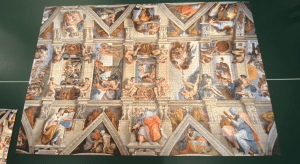
  4. Do a jigsaw puzzle, maybe while also listening to an audio book. This 5,000 piece puzzle got me through an especially stressful time.
  5. Workout/walk/run/whatever to some angry music. It helps flush the stress out of my system. Just search ‘Angry’ on Spotify and pick a playlist.

Amanda Kaczerski

  1. When I’ve had a stressful day, I like to run/exercise (on the super stressful days I’ll do some kick boxing!). I find that it helps clear my mind of the day and the stress. During the stress of the day, I really do appreciate doing some deep breaths and walking away from my computer. It helps me assess what the stressor is and determine how to move forward.
  2. I had someone remind me one day that what we do in grants isn’t life or death. If we don’t get to review all the requests by a set date, will anyone die? No. If we don’t get a grant into a system by a date, will anyone die? No (although I’m sure the requestors may feel that way). Pausing for a moment and recognizing that I can only do so much with my time and that even through the asks, assignments, and responsibilities seem like they all are urgent, it helps me stay focused and calm down a bit. Then with a calmer mind I determine what I will prioritize, what I may be able to delegate, and what just needs to be put to #2 or #3 on the list. This helps me when I’m stressed with multiple projects going on at the same time and being pulled in many directions. It’s taken me a while to learn that it’s ok to tell someone you need a few extra days, it’s OK to say no to accepting a new project or invitation to a new workstream, and it’s OK to let an email sit unread while you prioritize another task.
  3. Lastly, I do like to start my day with some quiet time and meditation to try to help me stay focused and grounded.

David Clausen

  1. 30-second deep breathing exercise with eyes closed and positive thought generation
  2. 35-minute Cross Fit workout w/ heavy bag hitting