Setting Expectations

On March 12, the beginning of the pandemic lockdown in Philadelphia, I posted the following on Facebook:
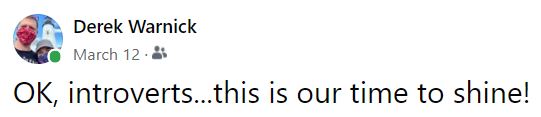
Three weeks later:

Six months later (note from Scott: technically, five and a half, but whatever) and these same people are still in our houses, which is why I am hear to talk to you about setting appropriate expectations for the day of CMEpalooza, now less than a month away (Wednesday, October 14, if you forgot).

Let’s all be honest and admit that there is a nonzero chance that one of the following things will happen during any virtual conference:

  • A panelist’s video or audio feed glitches because they have multiple kids at home sucking up all the bandwidth with virtual school or watching episodes of Cobra Kai or both at the same time (both of my kids will be home for virtual school during CMEpalooza. Say a little prayer for me and Verizon FIOS on October 14.)
  • A viewer watching the livestream at home has their video start buffering or pausing. We sometimes get complaints about this in the eval comments, so it’s time for a little come-to-Jesus moment: It’s not us, it’s you. If the video you are watching starts buffering, it’s because of an issue with your internet…probably because you have multiple kids at home sucking up all the bandwidth with virtual school or watching episodes of Cobra Kai or both at the same time.
  • Someone’s kid/spouse/pet appears on screen because they didn’t realize or didn’t care that there was a video call going on. Frankly, at this point I’m disappointed when it doesn’t happen. Seriously, when was the last time someone’s cute kid or pet showed up on screen and it didn’t make you smile? We should start making it a requirement.
  • Power outage. It happens. Fortunately we can usually just have people use their phone and everything is fine. It’s not yet happened to Scott or me, but we have had some close calls (my power went out for 15 minutes one year.) My neighbors are currently having an addition put on to the back of their house and the idiots gentlemen working there have already cut our power once.

One of the unexpected pleasantries that has evolved from the bloom of pandemic-initiated virtual programming is that it has made me feel much better about the production value of CMEpalooza. Watching media monoliths like ESPN and CNN experience the exact same technical issues that we sometimes have during CMEpalooza has definitely been a boost to my self-esteem.

There will be glitches. There will be interruptions. There will be mistakes. The show will go on and it will be fine.

Because I know it will annoy Scott, I wrote a haiku to summarize the moral of this post. I call it Pandemic Haiku.

it’s fine it’s fine it’s
fine it’s fine it’s fine it’s fine
everything’s fine

(note from Scott: Don’t tell Derek, but once again he failed to count syllables properly — check line 3, doofus — so this is not technically a haiku and I am OK with it)

(note from Derek: You come at the king, you best not miss https://www.howmanysyllables.com/words/everything’s)

Feeding CMEpalooza

[3 months ago]

Derek and Scott return to their secret lair somewhere in northwest Philadelphia, last visited in March, to discuss Derek’s latest idea for CMEpalooza.

Scott: “OK, I’m here. What?”

Derek: “Now here me out on this, but what if we have a meal for everyone?”

Scott: [stares directly at Derek, a look of profound incredulity on his face]

Derek: “Pretty good idea, right?? I knew you would love it.”

Scott: [opens mouth to talk but says nothing as it continues to hang open]

Derek: “Go ahead — you can tell me how much you love it.”

Scott: “Um, don’t we run a virtual conference?”

Derek: “Correct!”

Scott: “There are no people physically here.”

Derek: “Yes.”

Scott: “There are no meals.”

Derek: “Right.”

Scott: [stands up to leave]

Derek: “No no no no no no….wait! Wait! Grubhub! Grubhub!”

Scott: [glaring] “What?’

Derek: [talking fast] “We can give everyone Grubhub vouchers. They’re only good for the day of the conference and people can use them to buy food to eat while watching a session.”

Scott: [slowly sits back down]: “That is…not a terrible idea. We can’t afford to send every participant who watches a voucher, though.”

Derek: “Maybe we can add it to the Sponsorship Prospectus and ask some of our amazing sponsors (who will definitely not read this in a blog post 3 months in the future) if they would like to support it.”

Scott: [folding his arms] “This is actually a pretty good idea. I like it.”

Derek: “Thank you.”

Scott: [eyeing Derek suspiciously] “What else?”

Derek: “Nothing.”

Scott: [still looking doubtful] “Really?”

Derek:“…so about that Sixers post I suggested back in Mar-”

Scott: [slams door on way out] [peels out in driveway]

We are still looking for sponsors for CMEpalooza Feeds the People, which you can read about it the Sponsorship Prospectus. If you are interested in supporting it or finding out more details, please email Scott at scott@medcasewriter.com.


Educator, Teach Thyself

Why do we have CMEpalooza? Why do we have the Alliance conference? Why do we have the ACCME Newcomers’ meeting or CME Live or the Informa Connect–CBI’s Grants summit?

We have them to teach. We have them to learn. We have them to stay informed.

As CME professionals, it is resources such as these that we utilize to stay at the top of our game as we educate healthcare providers around the globe. We want and expect the most current and accurate information available. Never has this been more vital than in the middle of a pandemic where we are faced with the dual challenges of providing rapid education on a poorly understood disease and doing so via digital platforms that are unfamiliar to many.

[This is the part of the blog post where I channel my inner Grandpa Simpson and shake my fist at political clouds. If that sort of thing bothers you, now would be a good time to stop reading. I recommend clicking over to this article in Vulture that ranks every single Radiohead song.]

It has become even more important now, during a period of time where information that doesn’t align with a given individual’s world view is labeled “fake news” and ignored with no accountability. Facts, data, and research are brushed aside in favor of amplified opinions. Career politicians scoff at the advice of career infectious disease specialists. A governor denounces the notion of listening to experts for guidance in front of a nationally televised audience and is met with a collective shoulder shrug.

But we, the CME community, cannot afford to be this cavalier in our views towards data and expertise. These elements are the lifeblood of the work we do and provide the validity necessary to gain the trust of healthcare workers that rely on the education we provide. If we don’t believe in science, then science will not believe in us.

And so, I write this blog post to implore all of you – implore all of us – to educate yourself. Educate yourself so you are equipped to respond when someone questions you. Educate yourself so you have an evidence-based reason behind why you are doing what you are doing and not because, well, that’s just the way we have always done it. Educate yourself because no one else is going to do it for you.

The tagline for Dr. Jen Gunter’s blog is “Wielding the lasso of truth.” I thought this was pretty clever when I first read it 6 years ago, but it has taken on a new sense of urgency and rebellion these past few years. It is OK to be smart and it is OK to seek out those smarter than you for their advice.

CMEpalooza Fall is coming up on Wednesday, October 14 and there are going to be a lot of really smart people talking (much smarter than Scott or I. I can’t even remember my Netflix password) who can help you spin your lasso of truth. There are plenty of other resources currently available or coming soon. Here are just a few of them: