Meet Your Roving Reporter

The summer between my junior and senior years of college, I took a forgettable internship at a newspaper called The Home News in East Brunswick, NJ. I honestly don’t even remember how I got the internship. It wasn’t like it was super close to where I was living at the time (at home, an hour away) and I didn’t know anyone there. I’m thinking maybe one of my aunts or uncles knew one of the editors and that was my in? Anyway, not important.

The newspaper staff didn’t really know what to do with me. This was a middling-sized paper (daily circulation of approximately 50-75K) without any sort of formal intern program in place. I was the only intern they had had in several years. So I got passed around to whoever had time and needed help. I covered some political events, did some copy editing, and even wrote some obituaries.

But the absolutely worst came on Saturdays when I would come in at 11 am and the assigning editor had absolutely nothing for me to do. Instead of turning around and going home, I would beg and plead for something. It wasn’t that I was such a go-getter, but more that I had just spend an hour on the Jersey turnpike and didn’t feel like hopping right back on. And so, more often than not, I got the worst assignment of all (yes, even worse than the obits) – the “man on the street” interviews.

As a part-time, introvert, I hated these. It entailed approaching random people in a random location, introducing yourself, and asking if it was OK to take their photo and record their response to a question of current interest. Super, duper creepy, right?

I would usually hang out in front of one of the local libraries for these interviews, where at least chances were OK that the people I approached would be somewhat coherent. And truth be told, more often than not people agreed to be photographed for the newspaper. But it still really sucked. I always felt like such a loser (time for Derek’s low-hanging fruit joke here [note from Derek: too easy]). Nonetheless, I always managed to suck it up and come back with something.

So since 2022 is officially the year that I overcome things I have have disliked (arugula salad, I’m coming for you!), I’m bringing back the “man on the street” interviews just in time for the Alliance meeting. Each day, I’ll be asking a hard-hitting question or two of a handful of the 500 400 200 (insert shruggy shoulder emoji) attendees and record their responses for everyone’s edification. I’ll likely add a few personal observations of the weirdness of attending a live conference for the first time in 2-ish years in the super fun era.

Maybe you even have something in mind you’d like me to ask everyone – I’m certainly open to suggestions. Just type something in real quick in the comments box below.
 

Exploring the Rocky Contours

A few years ago, a friend of mine introduced me to the Icelandic tradition of Jólabókaflóðið, which roughly translates to “the Christmas book flood.” It already sounds pretty great, right? It gets better.

The tradition, at least how I choose to believe it, is that on Christmas Eve all the families in Iceland give each other books and then spend the rest of the evening lying in bed reading and drinking/eating chocolate. This is the best holiday tradition ever!

Ever since finding out about it, I have insisted the Warnick family participate in our own version of Jólabókaflóðið, except I buy all the books, including for myself. I wrap all the books and act shocked and surprised when I open mine, which no one other than me finds amusing for some reason.

This year for Jólabókaflóðið, I bought myself When We Cease to Understand the World by Benjamin Labatut, which I have been looking forward to ever since I read about it in the New York Times Best Books of 2021 (“Labatut expertly stitches together the stories of the 20th century’s greatest thinkers to explore both the ecstasy and agony of scientific breakthroughs: their immense gains for society as well as their steep human costs.”)

It is a slim book with heavy ideas, most of which revolve around exploring the thin line between genius and madness, evil and the miraculous. I was particularly compelled by the story of mathematical savant Alexander Grothendieck, whose brilliance, as Labatut explains it, was in his ability to “recognize that there was something grander hidden behind every algebraic equation.” Grothendieck himself describes these grand hidden solutions being revealed to him “like the contours of a rocky coast illuminated at night by the rotating lamp of a lighthouse.” (Note from Scott: When did our blog posts become so thought provoking? I sure hope there is a Punky Brewster joke coming soon)

For me, this anecdote highlights one of my key takeaways from the book: in order to move from good to great, we need a willingness to expand our mind and open it up to possibilities outside of the traditional. We need to push boundaries and explore the rocky contours illuminated by Grothendieck’s lighthouse. We need to step outside our comfort zone (you know where this is heading…)

If you read this blog with any regularity, you know that we are currently accepting abstracts to present at CMEpalooza Spring 2022 (here are the details and here is the submission form.) I’d like to encourage those of you who are still reading this to use this opportunity to do your own boundary and comfort zone pushing. This will be different for different people. If you have never presented at an industry conference before, simply submitting an abstract is pushing. If you have only done solo presentations, gathering a panel to work with is pushing. If you have participated in panels, challenge yourself to think of something you have never done before. This is your chance to explore the rocky contours of presenting. We’ll try to illuminate as much of the coast as we can. (Scott again: Dammit. No Punky Brewster references. Next time…)

A Better Way to Submit an Abstract to Present at CMEpalooza Spring 2022

Today (yesterday by the time you read this) I learned two (2) new things.

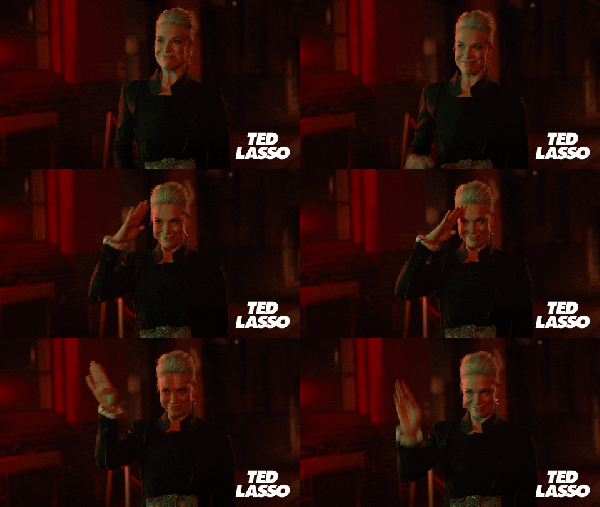
The first is that Rebecca Welton from Ted Lasso…


…is also Septa Unella (aka The Woman Who Cried “Shame”) from Game of Thrones.


Shocking, I know. I’m still recovering.

Less interesting, but just as important, the second thing I learned today is that the form I included in my Submit an Abstract to Present at CMEpalooza Spring 2022 post last week is not visible in the email version of the post, which is how many of you read the blog. I acknowledge that a form is not very useful if you can’t actually see it. My bad.

To make up for it, here is a link to the Google Forms version of the abstract submission form. I keep calling it an RFP. I don’t know why. Old habits die hard, I guess. Anyway, if you have a great idea for a session at CMEpalooza Spring, submit it here. Abstracts are due January 28. Don’t worry, I’ll send out more reminders.